
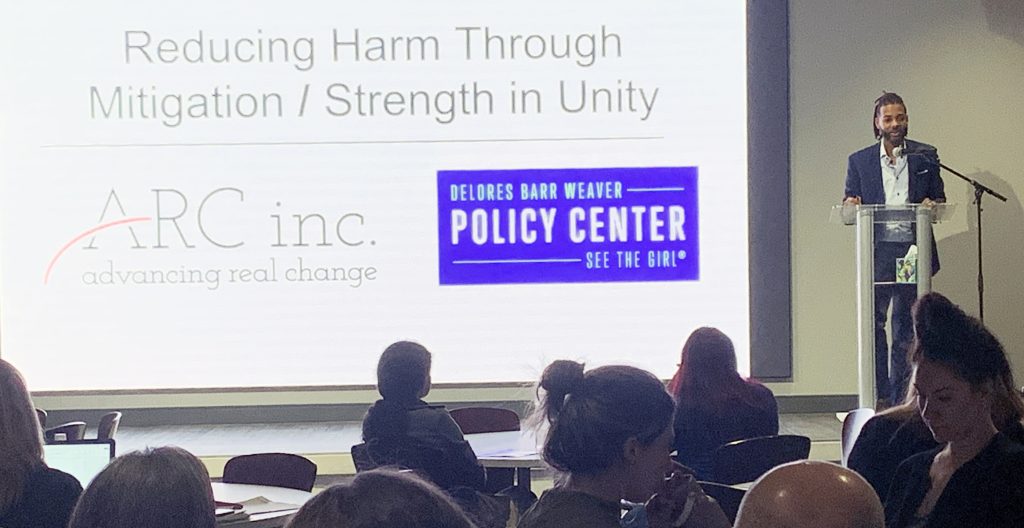
A Keynote from Isaiah M. Oliver, President, The Community Foundation for Northeast Florida
At our recent See the Girl Summit, we had the privilege of hearing from keynote speaker Isaiah Oliver, who shared invaluable insights on why support and invest in girls. His words sparked thoughtful discussions and provided a fresh perspective on how we respond and advocate for girls. We’re excited to share the full script of Isaiah’s keynote with you, so you can revisit and reflect on his message.

Let me start by saying—I’m honored to be here with you all at the See the Girls Summit. To be invited into this space, with women who spend their lives fighting for girls, loving girls, protecting girls, and walking alongside girls—I don’t take that lightly.
The title they gave me for this keynote, I believe, was something like:
Why support girls? Why protect girls? But the real question for me—the one that sits a little deeper in my chest—is: Why invest?
Why invest our time, our talents, our financial resources, our stories, our testimonies, our quiet prayers, and our loud advocacy in the lives of girls?
Because girls grow into the women who become our mothers, our aunties, our grandmothers. They become our community builders, our political leaders, our nurturers, our protectors, our healers. They become the backbone of our neighborhoods. They become the memory-keepers and the future-makers.
When you invest in a girl, you’re not just changing her life—you’re shaping a whole lineage.
And I know that firsthand.
And let’s be clear: the return on that investment is undeniable.
Research shows that when girls are educated, supported, and safe, everything changes. Communities see higher graduation rates, delayed parenthood, stronger economies, and better health outcomes. Girls who feel seen and supported are more likely to raise children who feel seen and supported. One girl’s stability ripples out for generations.
Investing in girls isn’t charity—it’s strategy.
It’s how we build a better future. It’s how we break cycles. It’s how we plant seeds for the kind of world we all say we want to live in.
But beyond the data, for me, it’s deeply personal.
It was a regular day in our house, and by regular, I mean the kind of day where my stepdad got the best of my mom—again. A physical altercation. Raised voices. Doors slammed. And I was almost there when it happened.
What strikes me now is how normalized it had all become. The behavior. The silence. The cleanup. The way we just… carried on. I never villainized her. Not even then. But I do think I struggled to fully name the villain, to fully see the damage being done.
My stepdad could be disarmingly kind to me. Not so much that I became an abuser myself—but enough to blur the lines. Enough that I didn’t understand how unsustainable it was. And maybe, enough to believe that this was love’s cost. I can only imagine how, for a young girl, being loved like that might feel… familiar. Might even feel like what love is supposed to be.
That day, the police came. I remember walking out of our house while they walked in. Our neighbors were yelling. The whole scene—loud and exposed—when what we wanted most was to keep it quiet. Manage it inside. Control the narrative.
We went to my aunt’s house, like we always did when things got bad. She was like a second mother to my mom—and a strong one. That day we ended up at a park, and I remember watching my aunt pull my mom in close and call her out—at the same time. She told her: You’ve got three kids. You’ve got to stop going back. It’s hurting you. And it’s hurting us. We can’t keep saving you from this only to watch you return.
And it was in that moment—watching her get parented, watching her shrink and absorb and process—that something changed in me.
I had only ever seen my mom as Mom. The protector. The enforcer. The one who made sure we ate, cleaned our rooms, did our homework, kept each other safe. But that day? I saw the girl. I saw the girl inside the woman. And I never un-saw her.
I saw the 12-year-old who came north to Michigan from Eden, North Carolina, sent by her mother to spend the summer with her older sisters. The same summer her mother died. The same summer she never got to go back home.
I saw the girl who stayed. Who became a teenager in a city that wasn’t hers. Who got raised by her sisters. Who learned to mother by being mothered by them.
And that day in the park, I saw her again. In real time. Not just as my mom, but as that same girl—being shaped, being scolded, being guided.
From that moment on, I couldn’t see my mom the same way. I couldn’t not see the girl. And I’ll be honest: I still see her. Every time we talk. Every time I look in her eyes. I see the grown woman, yes—but I also see the girl. The fragile, learning, surviving, still-growing girl.
That day, something was planted in me. A calling. I believe God showed me, not just who my mother was, but who I was called to be.
A protector of girls.
A believer in girls.
A safe place for girls.
A man who sees the girl, even when the world only sees the woman—or worse, refuses to see her at all.
Because every woman you meet was once a girl. Every woman still is a girl—somewhere in there. Our teachers. Our nurses. Our ministers. Our judges. Our elected officials. Our grandmothers. Our friends.
There’s always that delicate, powerful, complicated girl inside. And she deserves to be seen. Held. Nurtured. Protected.
So, when I’m asked why invest in girls?
It’s not because I read it in a report.
It’s because I remember the look in my mother’s eyes.
It’s because I saw the girl. And I’ve never stopped seeing her.
And I believe we all have a role to play. To build a world where girls can be their full selves. To create spaces where they are safe, and sacred, and celebrated. That’s how we grow stronger communities. That’s how we become who we’re meant to be.
Because when we invest in girls,
we invest in all of us.
And now, all these years later, I’m raising three daughters of my own. Three bright, curious, creative little girls who carry pieces of my mother, my aunt, and every girl who’s ever been told to shrink, to hide, to settle.
So, when I talk about investing in girls, I’m not talking about some abstract idea. I’m talking about them. I’m talking about their classmates. Their future. Their safety. Their brilliance.
Because I want to raise them in a world that sees them—and values them—not just for who they are now, but for who they’re becoming.
So yes—we support girls, we love girls, we protect girls—but we must also invest in girls.
Not just when it’s convenient. Not just when it makes headlines. But every single day, in the quiet decisions we make, in the policies we write, in the budgets we build, in the communities we shape.
We must invest in the fullness of girls.
We must invest in the girl and the grown woman.
In the butterfly and the caterpillar.
Because when we do that, we don’t just change lives.
We change legacies.
We rewrite what’s possible.
We build the kind of world we all deserve to live in.
Isaiah M. Oliver
President
The Community Foundation for Northeast Florida

What a phenomenal speech. I’m disappointed I couldn’t be there to witness it in person.
Thank you for sharing.