“Being a mentor to me is being a safe person. Being that constant. Being someone they can count on. I tell them early on — I won’t judge you. If your family’s involved, I show them I’m not going to go report everything back to mom or your guardian. That builds trust. I want people to say that I showed up when they didn’t have anyone else.
I knew I had overcome challenges in recovery, but I didn’t fully understand what it meant to be a survivor until I stepped into my role here. I wanted to be able to give back and be that support I once had.
I have so much compassion and each one of these clients just grips my heart — the most challenging or the sweetest ones. At first, I wanted to give them my all. But in this role, I’ve also learned boundaries. Still, this is where my heart is — helping others, helping survivors. It means the world to me. It means everything. I always try to be a light. That’s never changed about me. And it’s true what they say: when you love what you do, it’s not really work. That’s how I feel. I really love my job. It doesn’t feel like a job.
While I was in jail, my son’s father filed papers claiming I was unfit. My parents told me to sign them, so I did. I came out of jail with no baby and a long list of probation requirements. That moment started a 15-year downward spiral. I was a new mom who had lost her baby. I kept chasing comfort through drugs — and with the drugs came the trafficking.
You go through life and you don’t know what’s going on inside other people’s homes. And now, for my daughter, I’m learning to talk about the things that were never spoken in my house. I want to be open with her. The Policy Center has helped me grow as a person. It gave me the confidence to speak up in rooms where I used to feel invisible. I’ve learned it’s okay to have a different voice. We’ve been there, you know? We’re the perfect ones to speak up — we’ve been in those shoes.
I came to the Policy Center in August of 2022 as a Survivor Mentor I. And I’m now a Survivor Mentor II. I’m very proud of myself for that. I hope I can go on to Survivor Mentor III — so I can continue advocating for the girls, go to court with them, help them get their GEDs, birth certificates, IDs. For the girls over 18, my work is more like case management. For the younger ones, it’s about presence. We sit in my car, go to the library, take a walk — and we just talk. I just meet them wherever they’re at.
The reputation that the Policy Center has is amazing. It’s significant. Being here at the Policy Center is where I really learned to advocate for myself and others. It empowered me. Now I feel confident being in those rooms and standing up for our clients.
One of the most memorable things was a client, 16 years old, actively being trafficked. When I first met her, she said, “Nope, not me.” But the next time, she said, “I’ve had time to think about it. I was trafficked.” She didn’t see herself as a victim at first. But she listened. And I didn’t want her to carry that guilt, thinking it was her choice. It wasn’t. Another client was still in the life and graduated with her CNA. We went to her graduation. One of my girls was valedictorian at The Performers Academy in Jacksonville. Four of ours graduated that day.
My client that I’ve had for three years, she just turned 16. I’ve had her since she was 13. When she was younger, it was a lot. But now — no nicotine, no alcohol. She’s substance free. It’s been amazing to witness that journey. I want her to believe she matters. That she is worthy. I hope when we’re done, she feels she is valued. That she has self-esteem.
What keeps me going on the hard days is the small wins. Maybe it’s just a client responding to a text — even if it’s a week late. That still counts. She responded. That’s a win.
I like to be that safe space, that most consistent person they might have in their life. Some of my clients have met with me every week for years — not because they have to, but because they want to. I feel like I’m supposed to be exactly right here.
Not all of our stories are the same. Even survivors can start comparing: hers is worse than mine. That’s not always true. Just because one story sounds different doesn’t mean it’s not just as traumatic. We’re people. We’re people who’ve been through some really unfortunate things.
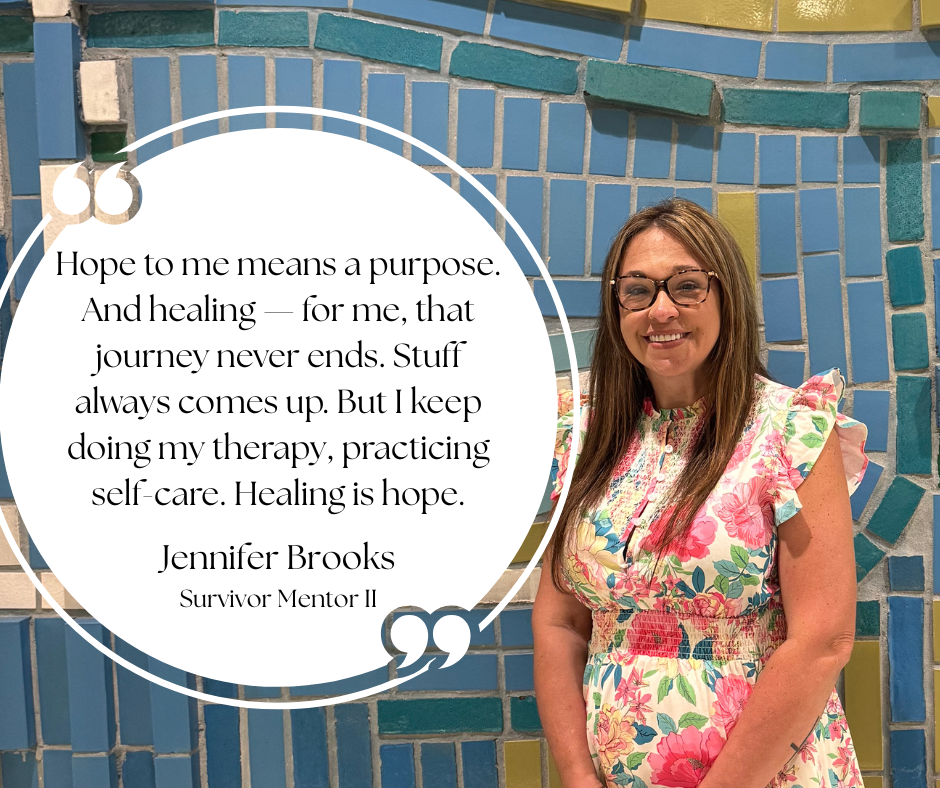
Hope to me means a purpose. And healing — for me, that journey never ends. Stuff always comes up. But I keep doing my therapy, practicing self-care. Healing is hope.”
—Jennifer
