See the Girl Through Advocacy: Why Words Matter in the Fight Against Exploitation
Florida House Bill 245 (HB 245) in Legislature updates statutory language about child exploitation language.
- Replaces the term “child pornography” in statute with “child sexual abuse material.”
- This shift reflects a growing recognition that the material documents abuse rather than consensual activity
While this may seem like a technical update, we also understand that language shapes how society understands harm. The words used in law influence how cases are investigated, how victims are perceived, and how communities talk about exploitation.
For organizations committed to protecting children, this change represents an important step toward ensuring that the law accurately reflects the reality of abuse. The term “child pornography” has been widely criticized by survivors, advocates, and researchers because it implies elements of consent, choice, participation, or commercial adult activity. Pornography is typically understood as material created by consenting adults.
And yet our laws state that children cannot consent to sexual activity. When images or videos depicting sexual acts involving minors are created, shared, or sold, they are not participating in pornography, they are being sexually abused. The phrase “child sexual abuse material” more accurately describes what the content represents: documented evidence of abuse.
It is a major win when our laws and language start reflecting the lived experiences of the child.
Seeing the Child Behind the Evidence
At the Delores Barr Weaver Policy Center, our work centers on a simple but transformative principle: See the Girl.
Behind every image, video, or case file is a child whose life has been profoundly impacted. When the law uses language that minimizes that reality, it risks masking the harm and distancing us from the human story.
Changing terminology does not solve exploitation on its own. But it signals an important shift: recognizing that these materials are not simply digital files or criminal evidence, they represent real children who were abused.
Updating statutory language has practical implications as well. When laws use terms that accurately describe abuse, it helps:
- Reinforce victim-centered approaches in investigations
- Reduce stigma for survivors whose abuse has been recorded and shared
- Improve public understanding of exploitation
- Align state law with national standards and advocacy efforts
It also reflects a broader shift toward trauma-informed and survivor-centered policy, where systems recognize the lived realities of those who have experienced exploitation.
Policy change often begins with small but meaningful steps. Updating the language in Florida statutes acknowledges what survivors and advocates have long said: children depicted in these materials are not participants. they are victims of sexual abuse.
At the Policy Center, we believe that seeing the girl means recognizing her dignity, her humanity, and her right to be understood through a lens of protection rather than exploitation.
Sometimes that work begins with something as powerful as changing the words we use to describe harm. Because when our laws see the girl, our systems are better positioned to protect her.
How You Can Help Support Survivor-Centered Policy
Community members play an important role in helping thoughtful legislation move forward.
- Contact Your State Legislators
One of the most effective ways to support legislation is by reaching out directly to elected officials in the Florida Legislature. Constituents can call or email their State Representative or State Senator to express support for updating Florida statutes to use survivor-centered language.
Messages can be simple and respectful:
- Share why accurate terminology matters
- Emphasize that children depicted in these materials are victims of abuse
- Encourage legislators to support HB 245 as it moves through committee and floor votes
Even a short message from constituents signals that this issue matters to voters.
- Educate Your Community
Many people are unaware that the term “child pornography” is still widely used in law despite its harmful implications.
Community members can help by:
- Sharing information about why advocates use the term child sexual abuse material
- Posting educational resources on social media
- Discussing the issue in schools, faith communities, and civic groups
Changing public understanding is often a key step toward changing policy.
- Support Survivor-Centered Organizations
Organizations working to prevent trafficking and exploitation, including the Delores Barr Weaver Policy Center, play an important role in educating policymakers and communities about the realities of exploitation.
Supporting these organizations through:
- Donations
- Volunteering
- Attending community events or trainings
helps sustain the advocacy and research that inform stronger laws.
- Follow the Bill’s Progress
Legislation moves through several stages, including committee hearings and floor votes.
Residents can track HB 245 through the Florida House of Representatives website to stay informed about:
- Committee hearings
- Amendments
- Voting timelines
Staying informed allows advocates to engage at the moments when legislative input matters most.
- Elevate Survivor Voices
Perhaps most importantly, policy conversations should center the experiences of those who have lived through exploitation.
Sharing survivor-informed research, amplifying survivor advocates, and supporting trauma-informed approaches ensures that laws reflect the realities faced by children and young people.
Policy change does not happen in isolation. It happens when communities, survivors, advocates, and policymakers work together to ensure our laws reflect both justice and compassion. By supporting efforts like HB 245, Floridians can help ensure that the language in our laws recognizes what these materials truly represent: evidence of abuse and the need for protection.
RESEARCH CORNER
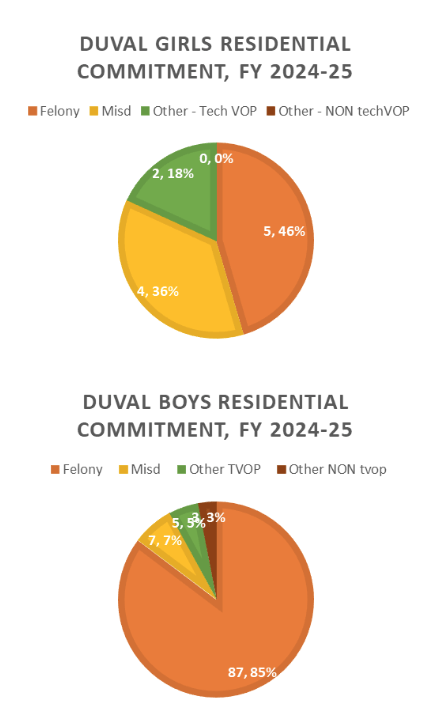
The Department of Juvenile Justice recently released data for the 2024–2025 fiscal year. Our research team analyzed the findings with a focus on how girls are impacted, revealing significant disparities in residential commitment outcomes for girls in Duval County. Girls are incarcerated for less serious offenses compared to boys: 85% of boys were committed for a felony offense, while only 46% of girls were committed for felonies. In contrast, 36% of girls were committed for misdemeanors compared to just 7% of boys, and 18% of girls were incarcerated for technical violations of probation compared to only 5% of boys.
These findings underscore the urgent need to reexamine how and why girls are entering deeper levels of the juvenile justice system for less serious offenses.
