
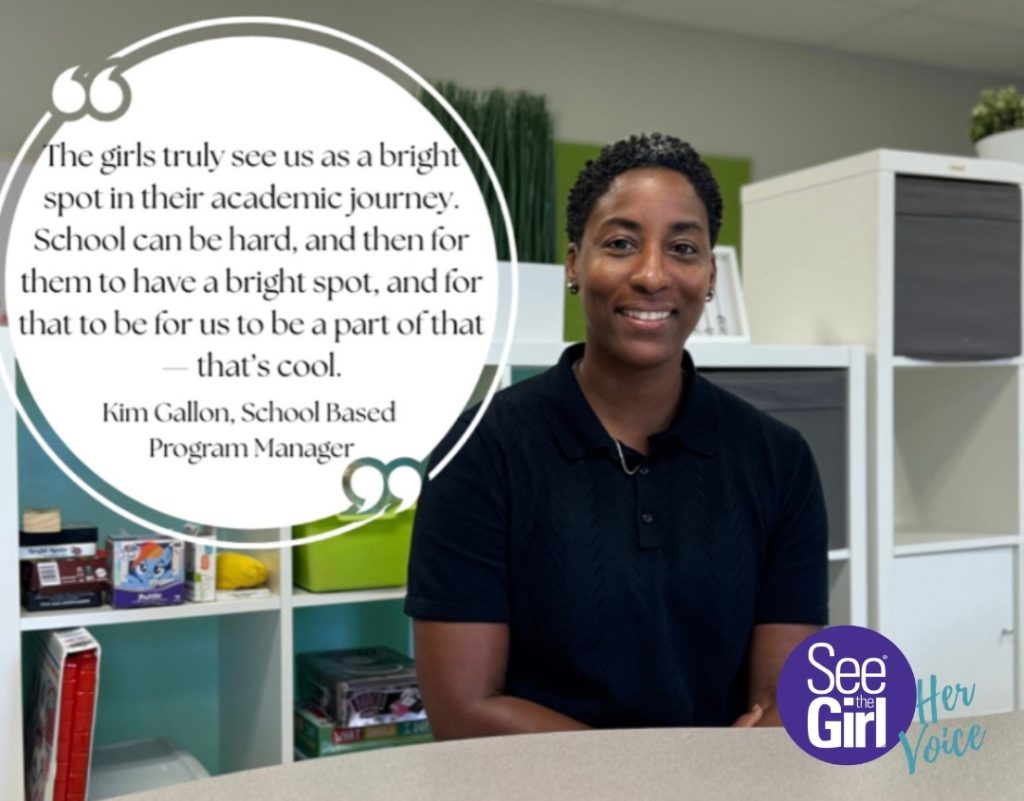
My goal has always been to be consistent, be a person of my word. If I say I’m going to do something, do it. We have families who have been disappointed by agencies who have overpromised and under-delivered. I’ve had to do very hard work, make very hard decisions, but the least I can do is show up for the family and say, ‘This is what I’m going to do to make sure that this doesn’t happen.’
I think how you show up for parents is the same way you show up for girls and their families– you do what you say you’re going to do. And then you can be trusted . I don’t have expectations of parents because I don’t know all of their stuff. I know what they tell me. But they at least know the expectation for me. It creates safety when I feel like there is a clear understanding of what the expectations are or what my role and responsibility is. The least I can do is create safety through my actions. I can’t control a teacher suspending your kid, I can’t control that you may get evicted. But what I can do is do what I tell you that I’m going to do. And I can give you resources, I can make some phone calls. I think that is how you show up best for parents, girls, and truth be told anybody, is to be consistent and do what you say you’re going to do. It’s just being honest and setting the expectations, making the expectations clear, making my role and responsibility very clear. And at the end of the day, just doing what I say I’m going to do.
The school programming was at first “Girl Matters” for maybe two years, and now it’s “See the Girl.” And that actually evolved into the community. It just caught on, because at the end of the day, we are seeing the girls. So I will say I’ve grown because the program has grown and I’ve been given the opportunity and the trust to expand it. To be heard, be seen, not only as a site supervisor, but for my expertise to truly be valued. I love the work. You know, I’ll be honest, I love the work. I love grassroots programs, starting from the bottom and watching it grow.
It was a four-year demonstration project. That’s what they pegged it as. And they were very clear, ‘We’re not sure where it’s going to go, but we know we want to do this for four years.’ And I was like, ‘Cool, because probably in four years, I’ll be ready to go.’ And then it just kept evolving. It gave me more room to grow in program development. And so I will say that’s probably how I’ve grown the most is I’ve really grown with the program. I’ve seen the ups and downs. I know what works. I know what doesn’t work because I was there in the first four years when it wasn’t working. So I’ve seen it — I’m not saying that I’ve seen it all, but I’ve seen enough.
If I went to another job, I wouldn’t be fulfilling why I’m here. Seeing what I’ve seen and being a part of the programs that I’ve had the opportunity to be a part of, has also shaped me as a human. I know that at the end of the day, what type of human I am and who I am to people is really important. The work is needed. The work is valuable. And if you want to leave your mark in a different way, this is a job for you. This is a field for you. I don’t know if that is what your end goal is, but if your end goal is something different, this is it. This is it.
My program is different — we are school-based only. And my work and my team members, our work is at specific schools. That is where we report every day. And the goal is also to be a part of the school culture, where we’re not this outside program coming in and doing something and leaving. We have space there. We’re set up there. And like I said, we want to make sure that we are team members more so than somebody providing a service.
We have interns who come in, but actually what they’re doing is they’re giving girls skill-building lessons to help them work on things like communication and identifying their emotions. How can they strengthen their self-esteem? What does safety look like? What is it that you can do to make sure that you’re in healthy relationships? Because a lot of our girls, unfortunately, they don’t have the model on how to resolve conflict without fighting, yelling, cursing, screaming.
Their model is fighting, yelling, cursing, and screaming. And so what we try to do is give them the skills to do something different and hope that it trickles over into not only how they operate in their day-to-day life at school, but then also how they operate at home. And then if there’s some other issues that we can help them with, like counseling and things like that, we make sure that’s put in place.
We also give them supportive services, but to me, the bulk of the program is the skill building that the interns are doing with them. On top of providing those services for girls, being their advocate, we also make sure that we are creating a culture within the school where we are the model on how to treat girls who are in a crisis. We’re also the model for the teachers. The goal is to be the model for the girls and also the model for staff and school administrators, so they can do something different to ultimately reduce suspensions. That is the ultimate goal — to reduce suspensions. All of the other stuff is helping her be a better person, but how we can measure that is: last year she had 15 referrals, this year she may have eight. Something is working.
We’ve done trauma and triggers training for teachers and staff so they can identify what trauma and triggers can look like. And then we have done trainings on how to reinforce students in a positive behavior. It really just depends on what the school needs — it can range from mental health resources to some actionable things that teachers can do in their classroom. It just depends on the needs of the school.
I think what could help schools is more training. The Policy Center has partnered with Duval County School Resource Officers, and we have provided training for them the past two school terms. It’s even branched off into St. John’s County as well. So I think that’s the start, is the training. I think we have to also give grace to educators. They didn’t go to school to do what we’re doing. They went to school to be educators. And so I can’t expect for them to see a child through the same lens that I see a child or have the opportunity to impact a family differently. So I think it’s the training and grace that we need to give administrators. Being ignorant is no longer an excuse.
Work is uncomfortable. You know, changing your behavior and patterns is uncomfortable. Administrators want her to pass a test, but it is also important for her to learn how to manage her anxiety and have coping strategies, so she can stay in class longer. If a girl is solid emotionally, she can pass any test. We don’t have students in this building who can’t pass a test. We have things that get in the way of them passing the test. And we’re trying to bring down those barriers. You have to understand that it’s more than testing strategies.
For the summer, the school programming stops, but then we pick up partnerships with after-school programs or the Boys and Girls Club, and we provide summer groups for girls. We provide girls with skill building in a fun way. Our curriculum is very interactive; they can make crafts, vision boards, it’s very hands-on. We’re there once a week for 45 minutes and then you see me the next week, and this is only going to last for eight weeks. But we want to make sure that we’re a resource to the parents if they need additional help.
What I’ve noticed is as they get older, how they feel about school changes. I can do an assessment on a third grader and they have very high remarks about their school — ‘I like coming to school, school is cool. I feel safe at school.’ And then come fifth grade, they don’t feel the same about school. Those are the times that are challenging for them. That’s when more bullying is happening, when they’re still coming into their own, when they’re trying to create an identity for themselves. And so I think self-esteem plays a lot into how they view not only themselves, but also how they view their environment, their community, where they belong, how they belong, and where they fit.
I want people to understand that our girls are just like any other girls in this city, no matter who their parents are, what their race is, what their background is, or how much money their family makes. At the end of the day, they’re the same girls. And I just hope that they’re not stereotyped and being told they are too much or who they are is aggressive. I want people to understand there’s privilege in having grace to figure out who you are. We need to give the girls the space and understanding that they’re going to make mistakes. Let’s not penalize them, and definitely let’s not criminalize them from making a mistake because they just didn’t know. They didn’t have the words. Let’s give — not excuses — but give them grace just like everybody else.
I think what I want for the girls is just to be able to be comfortable in who they are and use their voice. It’s really as simple as that. I hope that they have the freedom, time, and space. I don’t think people understand the privilege of having freedom, time, and space to find out who you are. So, one, I hope that they are able to do that. And then the second part is, is actually being able to use their voice.
The longevity of the program has been motivating. Just seeing it grow, evolve, go from school to school, the impact that we’ve had. The research reminds me that what we do matters — the work that we do is very important. My best friend works for the Dual County Public Schools, and she was working with a college readiness program. She was on a college campus and one of our fifth grade girls from the first year we had this program remembered who she was and remembered who I was. She was like, ‘Where’s Ms. Kim at?’ Like, they remember. That is so motivating.
When the majority think of something positive about school, it’s us. Now those students are truly adults. And they may have children now, or they may be in college, and they still remember the program. That is motivating — to give a girl a feel-good moment. And so it’s just those things that probably motivate you the most to just keep going, when I know that girls mention the program, mention me, or ask me how their intern is doing. That is great because that lets you know the impact that the intern had on them. So to me, that’s motivating — that girls truly see us as a bright spot in their academic journey. School can be hard, and then for them to have a bright spot, and for that to be for us to be a part of that — that’s cool.
—Kimberly
